Lead Story
Earning Energy Independence
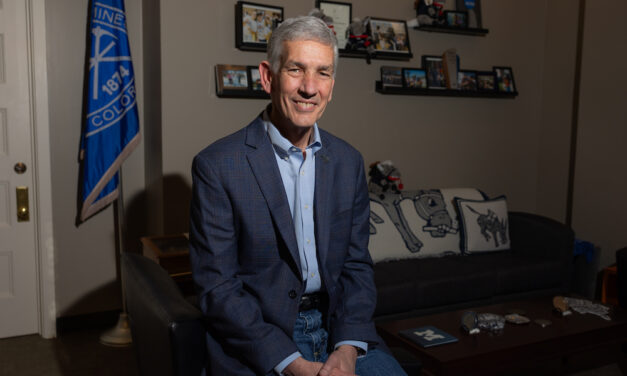
When Jennifer Miskimins MS ’00, PhD ’02 received her bachelor’s degree in petroleum engineering in 1990, the United States oil industry was still reeling from the ’80s price collapse, most major companies had shifted their exploration efforts overseas, and those remaining on shore were slowing production and focusing on the lowest-hanging fruit. Talk of an imminent “peak oil” crisis was escalating. And for bright, forward-thinking engineers, job prospects were bleak. A quarter-century later, the U.S. energy landscape couldn’t look more different.
[continue reading...]Here's the table of contents for the 2013 Spring issue.
Web Extras
- Mines Graduates Largest Class In History
- Internship with Bosch
- Finals
- How Nike’s Founder Helped Influence Cancer Researcher Joe Gray ’68
- Tips on Developing Your International Career
- Airstrips for the Allied Advance
- New Gravity Map Reveals a Battered Moon
- Did Arthur Lakes Discover T-Rex?
- Bob Lesage’s Contributions to Skier Safety
- George Saunders: Making the Media Circuit with ‘Tenth of December’
Feature Stories
Two summers ago on I-70, about a mile from the highest point on the nation’s Interstate Highway System, a dip in the pavement grew so large that cars were going airborne and getting tossed out of their lanes. Fortunately, no one crashed before the Colorado Department of Transportation made repairs, but drivers shouldn’t rest too easy; the Big Bump will be back. CDOT turned to Professor Ning Lu, an international expert on landslides, in 2009, and he’s partnered with the state’s engineers to gather baseline data about slope stability, with an eye toward developing a plan for a permanent fix.
Scooping ice cream or flipping burgers is honorable work for a college student, but some of the job opportunities for Colorado School of Mines students offer a lot more, kick-starting careers, forging community connections and pushing phyical limits. Interested in finding out which undergraduates had the best gig, we took a survey. Read on for our top five and comments from others who caught our attention.
Over the last 25 years, a series of incremental improvements to photovoltaic cells have raised efficiency levels from around 15 percent in the early ’80s to 20 percent today. However, after recent research at Mines helped confirm the effectiveness of quantum dots, scientists believe this new technology could elevate efficiency to 40 percent over the next 10 years.
Web Extras
During the 2013 Commencement ceremony, held on May 10, a total of 938 degrees were conferred, more than at any previous Mines graduation ceremony.
After moving across Germany, I’ve started my internship at Bosch! I now live in at the southern tip of Germany and work in manufacturing engineering for Antilock Brake Systems.
January and February were full of studying and exams. To set the scene a little bit, finals (Klausuren) in Germany work a little differently than in American colleges. Here, Klausuren are usually worth 100% of your grade. “Finals week” takes place during a span of two weeks.
Alumni Profiles
Graduating in the middle of the Great Depression, members of the Class of 1935 faced bleak job prospects. But E. Keith Staley ’35, who celebrated his 100th birthday on January 13 in Oro Valley, Ariz., points out that life had been tough for some time.
In 2012, Amy Clarke MS ’02, PhD ’06 produced a metallurgical first: movies that show bulk metallic alloys in the process of crystallizing.
At 6’2” and 275 pounds, with a slick, bald head, neatly trimmed goatee and several tattoos stretching across his biceps, Shane Carwin ’04 looks the part of an Ultimate Fighting champion.
Inside Mines
The chance to perform in the Vatican’s St. Peter’s Basilica—the world’s largest church and, acoustically, one of the most remarkable—would be a far-fetched dream for many musicians, but for 21 members of the Mines community, it’s one they realized last October when they performed during a Saturday evening mass.
A 1976 alumnus has contributed $5 million anonymously to Colorado School of Mines to support the university’s Underground Construction and Tunneling Program and to provide scholarships for undergraduate students.
In Chuck Stone’s course, Renewable Energy, students design their own field trips to companies or organizations involved in renewable energy or sustainability and outline their experience in a report.